Sunday, May 8, 2011

Working with People

One of the biggest challenges in Haiti remains working with people. We have a lot of frustration around this area. On the one hand – we like most of the people that work with us in the village. On the other hand - it’s very difficult for us to trust them to do their job and if we do trust someone – we’re often disappointed.
Some of the things we require seem very natural to us: watch your surroundings. If something is wrong – fix it. Think of ways to improve. We were hoping that the school teachers and directors would somehow adopt this state of mind but so far without success.
We currently have about 30 people working in the school and this number grows as we add buildings and programs. For most of them - this is the only employment opportunity. For each of the jobs, you can find dozens of other willing candidates. In my ‘western’ state of mind this fact would cause people to be very interested in doing good work in order to keep their job. In reality – we often have to remind people their promises and commitments. When we do approach people who are failing to do a good job, they usually prefer describing why other people are doing a bad job, and not talking about themselves. I think that my problem is with the expectation that people that are living under such harsh conditions would act different than people world wide.


Christine just started working as a cleaning lady in the new kindergarten. She has 6 kids, but they don’t all live with her. She cannot sign her name, but the two kids she sends to our school are both doing very well and getting good grades. Her other kids are going to other schools. She’s one of our favorite people in the village and watching her happily come to work in the afternoon makes me happy.

Saturday, May 7, 2011

Two months later…

Since this blog is read only by people that know me – you probably know that I’m still in Haiti. I didn’t write for a while for several reasons: I was busy, I was on vacation in Israel and…. the 3 legged purple alien stopped seeming strange.

Meanwhile: Haiti selected a president. The second round of votes and the result announcement were peaceful and everyone is expecting a peaceful entrance to office next week. We’re not sure if it’s us being optimistic or a real change but it seems that somebody has been cleaning the garbage off the streets since the election results were published. Cleaner streets are not only nicer and more hygienic. In my mind they are connected to giving dignity to the people walking and living there.

We are still living in the city and spend too much time in traffic on the way to the village every day. Every day in the street we still see:
-         someone fighting
-         people asking us for food
-         someone dancing
People are still trying to improve their situation over the other millions of miserable people, but not letting that stop them from being happy for the smallest excuse.

Couldn't find related pictures. Attaching unrelated ones (the school blog can be found on: http://zoranjeschool.blogspot.com/ )

Kids playing in the new school playground


We had a science fair


Tuesday, March 8, 2011

School Life

There were a few special events in the school in the last few weeks. Except for that, the school is running and dealing with problems similar to other schools around the world: discipline, maintenance etc.

Our special events include:
A valentine party (can’t find photos)
Preparing carnival:


School decorated - the day before
And celebrating it:

Kindergarten (4 years old)

School yard
Games
Dances (skirts made of torn rice bags)

Parade

And the first computer literacy lessons to the teachers. We’re hoping to get more computers and be able to give lessons to students as well.

If anyone is wondering, the lesson was delivered in bad creole.
Besides that, we’ve finally got electricity and internet in the school, and are building an arts workshop so more organized art lessons will start next week.

Sunday, March 6, 2011

What power? Power of Voodoo

On our first night in Jacmel, we were invited to a voodoo ceremony in a near by village. The Haitians are almost all Christians, but almost everyone believes in voodoo at some level and there is a large precentage of people that practice it regularly and a lot of people will go to consult the voodoo priest on health and other issues. There are people that practice ‘good’ voodoo that can help cure illness and stuff, and people that practice ‘bad’ voodoo in which curses are put on people making them ill, dead or zombie. A lot of people that become ill believe that it’s a curse that somebody put on them. Almost everybody we talked to about the subject (university students, business men, etc) has a story in which they saw a voodoo curse in action.
The way to the ceremony increased the effect of it. It was located in a village, and after crossing a river (needless to say – without a bridge), a motorcycle waited to take us to the venue of the ceremony.
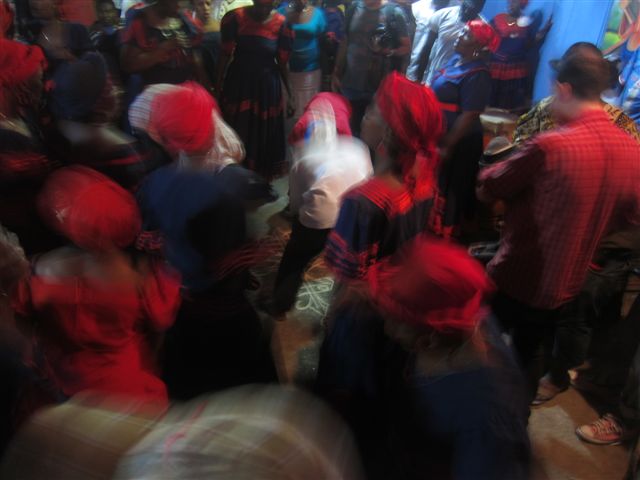
There was a lot of dancing and a priest that encouraged people to continue.

The ‘church’ had some strange symbols.

The highlight of the ceremony was a painting made with sand on the floor (while everyone dancing in the background), that was then totally erased by a group of dancers that danced on it.

Many of the pictures are fuzzy. Probably a curse.

Carnival

Carnival is considered by some Haitians as the biggest holiday of the year. In the past few decades it has changed from a costume and parade event into a huge-party-in-the-streets event. It seems to me that this allientated some of the previous participants and carnival is no longer for everybody. But – it’s still a huge attraction. The official carnival in Port-au-Prince is 3 days. This year, due to unsolved housing problems, the organizers were not able to build stands for spectators (as the usual place is occupied by tents) and only a few exist. Some artists preferred to skip the celebrations, and the route was cut short. On the first day we bought a ticket to one of the few stands that did exist and celebrated carnival from close, but from a safe distance. An unbelievably strong carribean rain just went the party was starting to pick up sent most if not all the celebrators back home early. No pictures as we took nothing with us when we went out to avoid pick pocketers.

Last week we went to Jacmel. The Jacmel carnival is a week before the big one, and is considered to be a friendlier ‘old-style’ event. We drove to Jacmel a couple of days before carnival day (in Jacmel it’s just one day) and spent most of the time in a beach house that belongs to a friend of a friend.

The carnival itself was as promised. Friendly, safe with a parade, people of all ages participating and happy dancing in the streets. Jacmel in general is clean, calm and friendly and I liked it a lot.


Monday, February 21, 2011

The NGO (aka: the art of networking, asking and begging)

Haiti ‘foreign aid’ is flooded with money. The BIG guys have billions of dollars allocated by governments and large global organizations to spend here. The problem is that the BIG guys are sometimes slow to respond, beaucratic and inefficient. We, on the other hand are tiny. There are at least a few hundred (but I suspect thousands) of small organizations / projects etc in Haiti. Buildling a single school somewhere doesn’t take much more than good will and some friends that want to help. Many of the schools are simply a tent in someone’s yard. Many are in a hut near a church etc. There are numerous organizations that are worrying about clean water, health, kids, micro financing, small businesses, infrastructure. There are even organizations that are focusing on animal rights in Haiti. Some organizations have a financial back. Some (like ours) rely on finding large donors, applying for grants and making partnerships with other initiatives that have resources and are looking for places to invest. For example:
Some NGO rep, any occasion, PaP: “I have an empowerment program for young women by teaching them karate”.
Any Prodev person happening to stand nearby: “We have a community center in a village. Did you ever think of the huge benefits of teaching village women karate?”

Of course most of the relationships are more serious than that. Both the UN and the CGI (Clinton Global Initiative), and probably others spend a lot of efforts on connecting people with joint interests and creating opportunities for people to meet. If you’re a small organization, and invited to the right places, and have the ability to understand how to make a puzzle from pieces that don’t really fit and how to convince people that you’re serious, you have a chance to get quite a lot of things done just from bringing in the right contacts.
For example, last week the following came to visit our school:
-         financed project for teaching young people life skills through construction (possible partnership: set up a construction training program in our vocational school)
-         financed project to run teen-aged girls social groups (possible: use our school / community center for this activity)
-         Farming Training initiative (early stage. Community activity, school activity, job creation opportunity, feeding opportunity all an option).
-         Financed initiative for short term infrastructure activities (possible: help us with the flooded school yard)
-         Community empowerment initiative (possible: join in running the community center / creating activities there)
-         Water filteration organization (will probably not happen as it is also not financed)
There may have been others. It’s sometimes hard to follow. But you get the point – our tiny NGO is busy getting as much help as possible from anyone that can give it with plans constantly adjusting to whatever is available. Somewhat unorganized – but gets things done.

This is going to be a kindergarten

Middle / Vocational School building

A basketball court

Driving (GTA* Port-au-Prince)

After the Christmas vacation we decided it was time for another step towards independence and started driving ourselves. We did drive in Haiti before, but not inside the city. The roads are very steep. Usually unpaved. With many holes. They are two way, but often not wide enough for two cars. The cars are huge (including ours), usually some kind of 4x4. There are people on the side of the roads. Walking, selling, buying, working. The side of the roads is often ON the road. Children try to cross, but there are no organized places for that. People are crossing with heavy loads of merchandize on their heads, or women with large buckets of water on their way back from the well (both inside the city and outside). At night there are no lights, and the dark skin color of the population only makes it harder. In addition there are tap-taps which are small pickup trucks that act as mini buses. They usually are packed full of people that are many times expected to jump in and out without the pickup coming to a full stop. Every little disturbance becomes a huge traffic jam in the streets that are already very jammed 80% of the time. And there are many accidents both due to the conditions and the fact that road rules are somewhat vague and the way to aquire a driver’s license is to pay someone to print it for you.
So, we drive. Carefully. Already scratched the car a few times, but all during parking - probably due to a combination of the size of the car and too much worrying about the many other elements of the street. We like being able to control our schedule, and not having someone always waiting for us, but after many years behind the wheel and being a confident driver – in Haiti I’m a ‘new driver’ all over again.

* GTA- Grand Theft Auto is a popular video game. I’ve never played it, but the stories I’ve heard remind me of what’s happening when I drive here.